Four Shingles or a Whole Roof? Ohio Ruling
An Ohio appeals court has sent a roof insurance dispute back for a new trial. The insurer said wind damaged four shingles, and the repair cost less than the deductible. The building owner's roofer said repairing them would damage the rest of the roof, so the whole roof had to be replaced. The court did not decide who was right. It ruled that a flawed jury question kept the jury from ever reaching that issue. This post is general information about the decision, not legal advice.

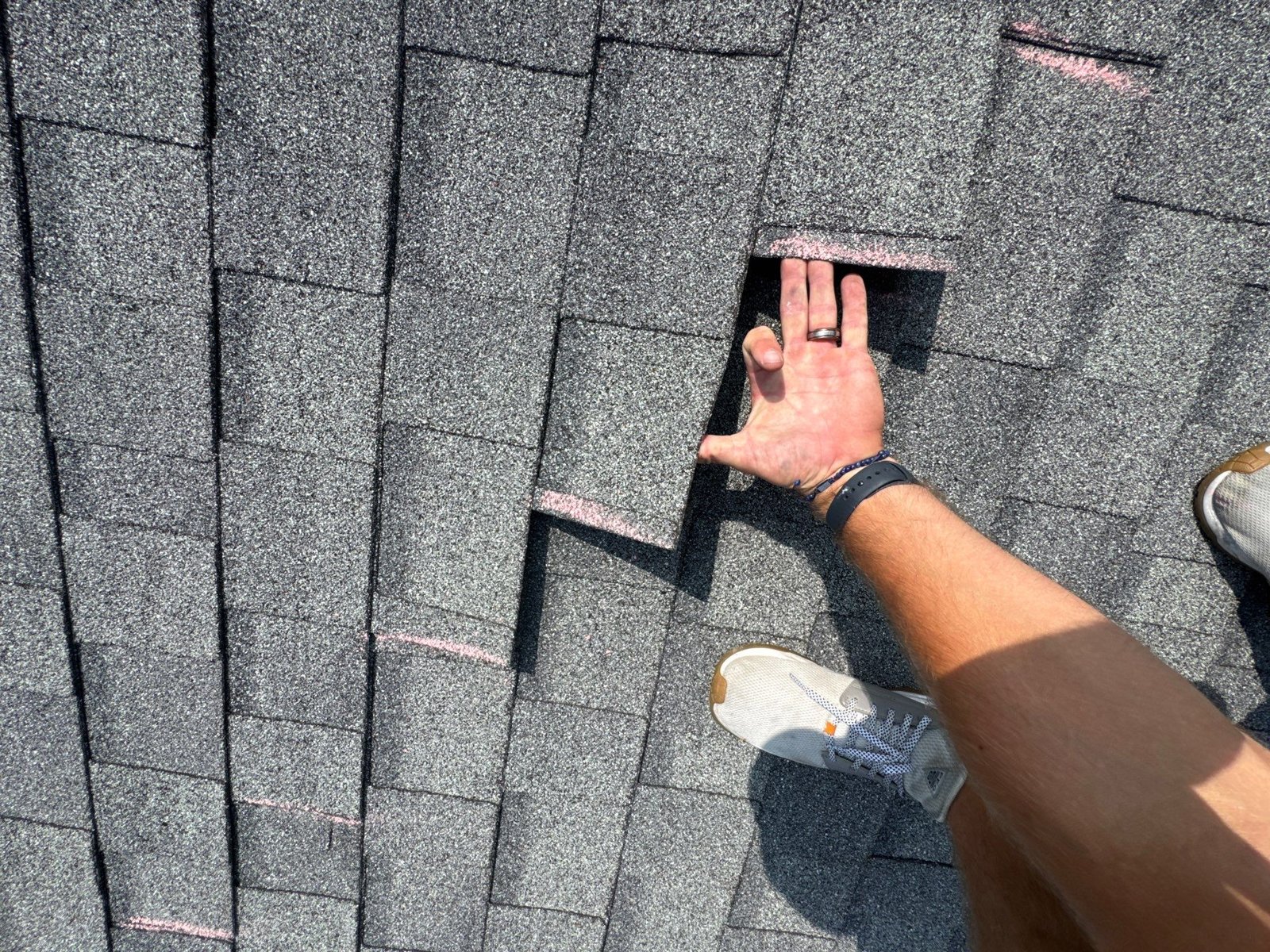
Checking how a shingle lifts during a roof repair visit in Maineville, July 2026.
What happened in Williams v. Erie?
The case is Williams v. Erie Insurance Co., decided Oct 30, 2026 by the Ohio Court of Appeals, Second District. It involves a commercial building in Piqua that was hit by a windstorm on July 20, 2023. The building was covered by a commercial policy from Erie Insurance.
Both sides agreed on the direct wind damage: four shingles, six appliques (the top layer of a shingle, according to trial testimony) and one ridge cap. Erie's inspector found that 4 of more than 12,000 shingles were damaged. Erie estimated that repairing the damage cost less than the policy's $2,500 deductible.
The owner disagreed. His roofer attempted the repair and said the roof could not be repaired. A manager from that roofing company testified that lifting a shingle pulls the seal of the shingle below it, so the replacement would not seal correctly. The owner argued that the insurer should pay about $70,000 to replace the whole roof.
Erie's side disagreed too. Its re-inspector, who had not inspected the roof herself, testified that with proper care the damaged shingles could have been replaced without harming the others. Erie also argued that even if the roof could not be repaired, the age of the shingles and how they were set caused that, and the policy excluded it. Erie's inspector had estimated the roof was about 20 years old.
What did the court decide, and what did it leave open?
The jury was given a written question that asked whether the windstorm caused damage "beyond the repair of four shingles, six appliques and one ridge cap." Neither side claimed the wind damaged anything beyond those items. The real fight was about what repairing them would cost. With that wording, the jury had to answer "No," and the verdict went to Erie without the jury ever deciding repair cost or the exclusion.
The appeals court, in a unanimous decision, found the question was "legally objectionable, did not address a determinative issue, and undermined the proper function of the jury." It ordered a new trial on the breach of contract claim.
It did not decide that the roof must be replaced. It did not decide that Erie owes anything. Those questions go back to a new jury. The decision also comes from one of Ohio's appellate districts and involves a commercial policy, so it does not set the rule for every homeowner claim.
What is Ohio's rule on damage caused by repairs?
During deliberations the jury asked how an Ohio insurance claims rule, Ohio Adm.Code 3901-1-54, applied. The trial judge declined to explain. The rule says: "When a loss requires replacement of an item or part, any consequential physical damages incurred in making such repair or replacement not otherwise excluded by the policy, shall be included in the loss."
Because the appeals court ordered a new trial on other grounds, it did not decide how that rule applies to this roof. If you are in a disagreement like this one, ask your agent or an Ohio attorney how it applies to your policy.
Why can four damaged shingles turn into a bigger repair?
Asphalt shingles are held down by a sealant strip. To replace one shingle, a roofer lifts the shingles above it. On some roofs, that can crease a shingle or break the seal on the ones nearby. On others it goes fine. In this case, the two sides' inspectors disagreed, and Erie's inspector testified he removed a shingle without creasing it.
That is why one claim can be about far more than how many shingles the wind took. The question is whether the roof around the damage can be repaired without causing more damage. Our guide on repair vs. replacement covers how we think about that call.
What can homeowners take from this?
The ruling is about trial procedure, but the dispute behind it is a common one: how much damage counts, and what does fixing it involve? A few practical steps:
Document the damage the day you find it. Take date-stamped photos, both wide shots and close-ups, of every damaged spot. Keep every estimate and message. Our after-storm checklist shows what to look for from the ground.
Ask for a repairability check before anyone patches the roof. Ask the roofer to show you, in photos, whether the shingles around the damage can be lifted without creasing or breaking their seals. Get the result in writing.
Ask the adjuster to be there. In this case, no one from Erie watched the repair attempt or went back to re-inspect. If a repair test is happening, ask the insurer in writing to attend or to re-inspect afterward, and keep that request.
Ask how the repair cost was figured. If the insurer says the repair is below your deductible, ask for the estimate in writing and compare it with your roofer's itemized estimate.
Read your policy for exclusions. Erie argued that age and wear excluded part of the claim. Your agent can explain what your policy says about wear, age and consequential damage. Our posts on whether insurance will replace your roof and recoverable depreciation can help you prepare questions.
Start with your insurer, then use the state if you need to. The Ohio Department of Insurance advises calling your company first and asking for a written response. If that does not resolve it, its Consumer Services Division takes calls at 800-686-1526.
How can Rooftop Relief help?
We do not decide your claim, and we cannot tell you what your policy covers. What we can do is document what is on your roof. Our free 25-point roof inspection takes 30 to 60 minutes and comes with a photo report and an estimate. For storm damage, we can meet your adjuster on site, and we send your insurer a Certificate of Completion when the work is done. You can read more on our storm damage roofing and insurance claims support pages.
If this week's storms or any other storm damaged your roof, call (513) 560-1181.
FAQ
Did the court say an insurer must pay for a whole roof if a few shingles are damaged?
No. The court ordered a new trial because of a flawed jury question. It did not decide whether the roof needed replacing or whether Erie owes anything. That question goes back to a new jury.
Does this ruling apply to homeowner policies in Cincinnati?
Not directly. The case involves a commercial building and a commercial policy, and it comes from the Second Appellate District in Miami County. Homeowner policies can have different terms. Ask your agent how your policy handles repairs that damage nearby roofing.
What is a repairability check?
It is a documented test of whether the shingles around the damage can be lifted without creasing or breaking their seals. Photos and a written result make it easier to explain the repair scope to an insurer.
Not legal advice
This post is general information about a court decision. It is not legal advice, and it does not tell you how your claim will turn out. For questions about your policy or a dispute with your insurer, talk to your insurance agent or an Ohio attorney.
Sources
Common questions
Did the court say an insurer must pay for a whole roof if a few shingles are damaged?
No. The court ordered a new trial because of a flawed jury question. It did not decide whether the roof needed replacing or whether Erie owes anything. That question goes back to a new jury.
Does this ruling apply to homeowner policies in Cincinnati?
Not directly. The case involves a commercial building and a commercial policy, and it comes from the Second Appellate District in Miami County. Homeowner policies can have different terms. Ask your agent how your policy handles repairs that damage nearby roofing.
What is a repairability check?
It is a documented test of whether the shingles around the damage can be lifted without creasing or breaking their seals. Photos and a written result make it easier to explain the repair scope to an insurer.