Know Your Roof · Gutters
Downspout: Parts, Sizes and Placement
Quick answer
A downspout is the vertical pipe that carries water from your gutter down the side of the house and away from the foundation. The gutter collects the water and the downspout is the way out. A clogged, undersized or badly placed downspout is a common reason gutters overflow and basements get wet.
Last updated
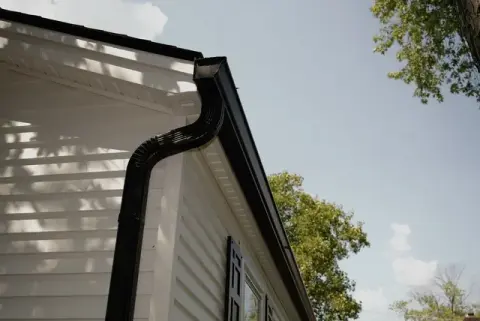
Rooftop Relief installs 6-inch seamless gutters with 3x4 downspouts.
Parts
The outlet is the opening in the gutter where the pipe connects. Elbows are the bends at the top and bottom, often called A and B elbows. Straps hold the pipe to the wall. An extension or splash block carries water away from the foundation.
Sizes and shapes
Rectangular downspouts, often 2 by 3 or 3 by 4 inches, are common with K-style gutters. Round downspouts usually go with half-round gutters. A bigger pipe moves more water and clogs less.
How many you need
A common guideline is one downspout for every 30 to 40 feet of gutter. Large roof sections, or places where a lot of water drains to one point, need more.
Where the water goes
Water should come out several feet from the foundation. Plenty of pros say at least 4 to 6 feet. Clay-heavy soil, which is common around here, drains slowly, so water left next to the house can work its way into the basement.
Common problems
Clogs at the outlet or elbows. Pipes that are dented or pulled loose. Water dumped right at the foundation. Too few downspouts for the size of the roof.
What do downspouts cost in Cincinnati?
Downspouts run $75 to $200 each, including extensions and splash blocks. The typical size Rooftop Relief installs is 3x4 inch. Cost depends on how many you need, the height of the wall, and how the water gets carried away from the house. Rooftop Relief gives free, itemized estimates.
Looking for another word? See the roofing terms glossary, A to Z.